
A Monopoly Trial With Lessons Far Beyond Music
The most consequential antitrust trial the modern entertainment industry has ever seen is now underway in a Manhattan courtroom. The U.S. Department of Justice alleges that Live Nation-Ticketmaster has illegally monopolized the live music market — controlling venues, ticketing, artist management, and promotions under a single corporate roof. A jury will spend the next six weeks deciding whether the company should be broken up.
But this isn't just a music industry story. It's a masterclass in vertical integration, pricing power, and platform dominance — forces that shape every corner of e-commerce and resale.
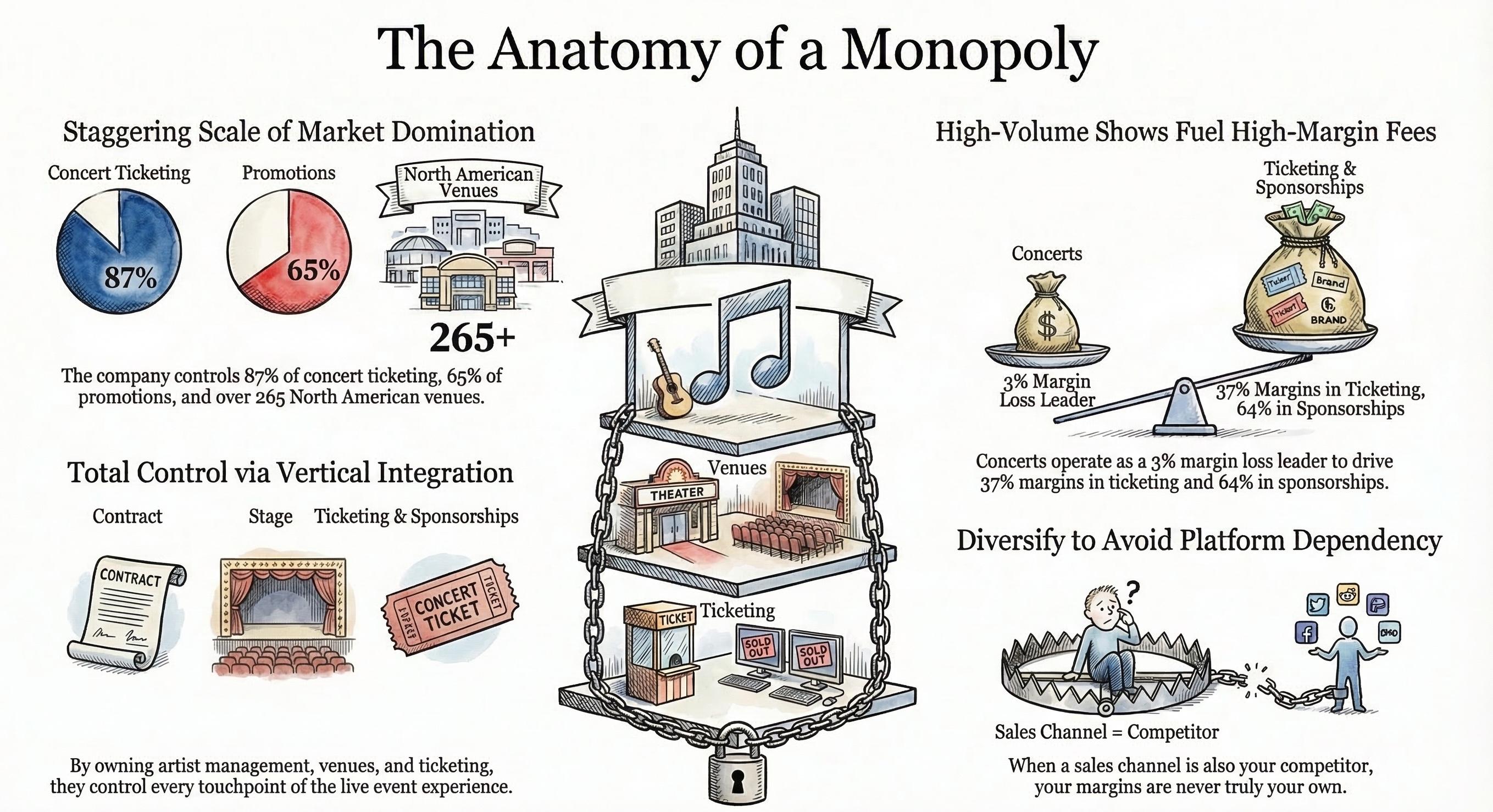
When one entity controls 87% of concert ticketing, 65% of concert promotion, and 265+ venues in North America alone, every participant in the ecosystem operates on its terms.If you run a resale business, a consignment shop, or a multi-channel e-commerce operation, the dynamics at play here mirror challenges you face every day: marketplace concentration, fee structures you can't negotiate, and the constant squeeze between platform power and operator margins.
What Happened
Live Nation merged with Ticketmaster back in 2010, creating a vertically integrated giant that spans nearly every touchpoint of the live event experience — from artist management and venue ownership to ticket distribution and merchandise sales. The DOJ filed its antitrust lawsuit in 2024, and the trial officially kicked off this week.
The scale of the combined company is staggering, especially in light of its most recent full-year earnings for 2025.
The business model is revealing. While the concert division generates 83% of total revenue ($20.9 billion), it operates on a razor-thin 3% margin. The real profit engine is ticketing — a 37% margin that netted $1.1 billion. Sponsorships and ads round things out with a 64% margin. In other words, Live Nation uses concerts as the high-volume loss leader that fuels enormously profitable service fees and ancillary revenue. Average U.S. ticket prices for top tours hit $135.92 in 2025 — up 41% from 2019 — yet attendance keeps climbing.
What This Means for E-Commerce and Resellers
The Live Nation playbook should feel familiar to anyone who sells on Amazon, StockX, eBay, or GOAT. A dominant platform sets the rules, controls distribution, and captures an outsized share of the value chain — while the sellers and creators who generate demand absorb most of the risk.
Consider the parallels:
| Dynamic | Live Nation-Ticketmaster | E-Commerce Marketplaces |
|---|---|---|
| Market concentration | 87% of concert ticketing | Amazon holds ~38% of US e-commerce |
| Fee pressure | Rising service fees on every ticket | Platform seller fees averaging 15-30% |
| Vertical integration | Owns venues, ticketing, promotion, management | Marketplaces launch competing private labels |
| Seller leverage | Artists and promoters have few alternatives | Resellers dependent on 1-2 platforms for volume |
| Pricing control | Dynamic pricing set by platform algorithms | Marketplace algorithms influence buy box, visibility |
The core lesson: when your sales channel is also your competitor — or when a single entity controls the infrastructure you depend on — your margins are never truly your own. Whether it's Ticketmaster adding service fees or a marketplace adjusting its algorithm, platform dependency is the defining risk of modern resale.
Lessons Learned
- Vertical integration creates moats, not just efficiency — Live Nation doesn't just sell tickets; it owns the venues, manages the artists, and runs the promotions. Resellers who control more of their own value chain (inventory sourcing, customer relationships, fulfillment) are far less vulnerable to platform shifts.
- High-volume, low-margin products fund high-margin services — Concerts at 3% margin feed ticketing at 37% margin. For resellers, this means thinking beyond the product sale itself. Authentication services, premium packaging, consignment management, and subscription models can all deliver margins that the core product cannot.
- Platform dominance invites regulation — The DOJ trial signals that regulators are paying attention to concentrated marketplaces. E-commerce operators should watch for similar scrutiny of the platforms they depend on, and diversify accordingly.
- Rising prices don't always kill demand — Ticket prices jumped 41% since 2019, yet attendance grew 9% in just two years. For resellers, this reinforces that pricing power exists when the product is scarce, experiential, or culturally relevant — categories that sneakers and streetwear consistently occupy.
Actionable Strategies
Looking Ahead
Whatever the jury decides, the Live Nation-Ticketmaster trial is a reminder that unchecked platform power reshapes entire industries. For resellers and e-commerce operators, the takeaway is clear: build your own infrastructure, diversify your channels, and never let a single platform become your only path to market.